The Technical Audit: Why Vaibhav Sooryavanshi’s Bat-Swing Faces a Structural Test in Manchester
A Rajasthan Royals teammate casts doubt on Vaibhav Sooryavanshi's style ahead of the Manchester T20I. Inside the technical analysis of his bat-swing.
Loading...

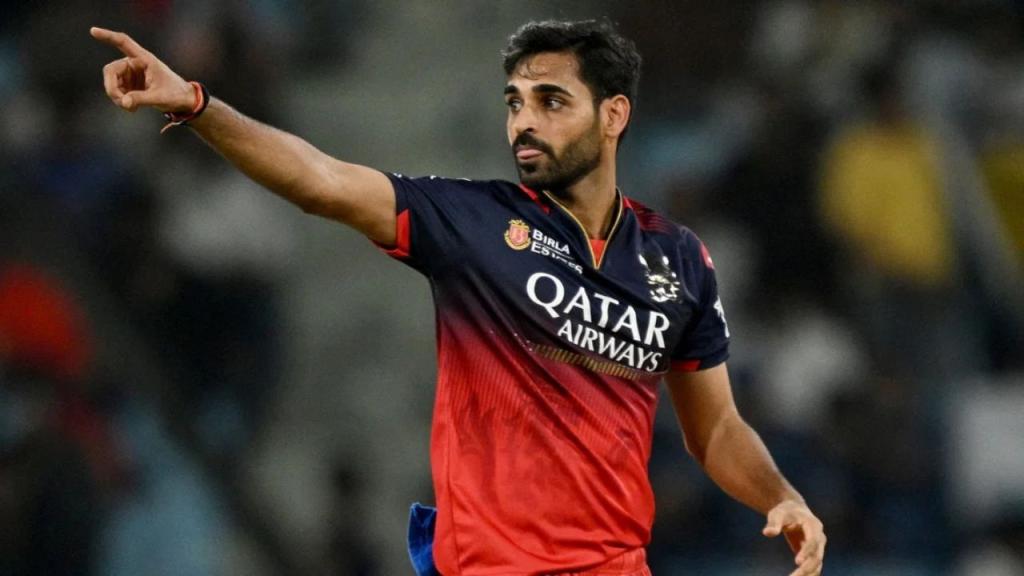
Analysis of Bhuvneshwar Kumar's 4/23 in Raipur. Discover the ways in which the 2.15m release height, as well as the strategic use of the city's vast borders secured the RCB's playoff position.
I sat in front of the nets for practice at the Shaheed Veer Narayan Singh International Stadium the other night, taking in Bhuvneshwar Kumar perform the same, almost meditational routine. He was not chasing the his swing. He was tracking the length of his strides. The last time we saw him in Bengaluru where we watched Mohammed Siraj struggle in the 12th over with KKR and leaking 22 runs as he was looking for a complete-length "miracle ball" on a flat deck. Bhuvneshwar Kumar was aware of the failure and plowed. In Raipur He didn't look for the wicket but constructed the cage.
Table of contents [Show]
Raipur is not the M. Chinnaswamy. The boundaries of the square here extend up to an imposing 80.2 meters. A bowler such as Bhuvneshwar Kumar who has had his average speed settle within the 132-135-kmph zone for the IPL in 2026 the dimensions of these provide a vital line of support. But size alone doesn't take wickets. It is essential that the surface work together.
This Raipur deck is heavy with "tacky" black clay. Contrary to the red clay of Mumbai that has a regular bounce, this clay has a high friction with the soil. If the ball hits the ground on the ground, the clay "grabs" the seam, which causes the ball to stay within the field for about one second more. It's not simply a slow pitch. it's also a misleading one.
The most interesting data item of Match 54 was Bhuvneshwar Kumar's release height. In keeping his height near the crease and delay his wrist snap Kumar was able to record an average height for release at 2.15 metres.
This tweak to the mechanical system altered the direction of travel. The ball, instead of sliding across the ball, it came into the deck at a more steep angle. When playing on the Raipur clay it caused the appearance of a "heavy-ball" effect. Rohit Sharma pulled his trademark pull three times during the Powerplay Three times, the ball came in higher and later than he anticipated.
This wasn't a mere strategy but an opportunity to catch. Through hitting the ball through a large length--that uncomfortably 6-to-8 meters away from the stumps Bhuvneshwar was able to ensure that MI batters could not get under the ball in order to get over the 82-meter barrier. They had to smash into the fence, however the surface friction made sure there was no timing error.
Although most experts look at Kumar's capability to swing the ball both ways, his performance during the IPL 2026 is based on his "dead-straight" seam. In Raipur the team reduced their shots in 25% when compared with his previous average.
Why? Since on surfaces that are slippery the swinging ball usually gets easier to hit when you account for the angle. Through bowling cross-seams as well as "scrambled" seam deliveries with an orientation that is vertical and a sloping bounce. It's a strategy change like Pat Cummins' 2023 World Cup final blueprint--denying the bat's speed and predictability and forcing them to produce maximum energy.
For a better understanding of how Bhuvneshwar Kumar proved so efficient You must examine the tension that he created on the other side. As Bhuvi made sure to get the most of the Powerplay Middle-overs enforcers employed"Raipur Trap" to finish the job "Raipur Trap" to finish the task.
| Batter (MI) | Bowler (RCB) | 2026 Season Metric | Tactical Outcome |
|---|---|---|---|
| Rohit Sharma | Bhuvneshwar Kumar | 58% Dot-Ball Rate | Forced Mistimed Loft |
| Tilak Varma | Bhuvneshwar Kumar | 4.2 Economy (Head-to-Head) | Squeezed Strike Rotation |
| Tim David | Rasikh Salam | 148.4 kmph Peak Pace | Beaten by Velocity |
The end result of this tactic method resulted in the achievement of a dot ball percentage of 58% against MI's top two risky anchors: Rohit Sharma and Tilak Varma. In T20 cricket Dot balls are physically weighted. At the point that Bhuvneshwar was done with his third round his required pace increased by two scores per hour and not one wicket fell to an "big" shot.
He used his "corridor of uncertainty" not to locate an edge instead, he was able to deflect that pull shot. Each when Tilak Varma was looking to swing and hit the ball, he saw it hitting the back of the bat. That is the mark of an old-timer who has successfully made the switch from being a "swing king" to a "surface specialist."
The RCB's success wasn't due to chance or MI's weak performance. It was an efficient performance of ground-specific bowling. Bhuvneshwar Kumar has proven that during the IPL 2026 brains will outshine pure velocity. As the tournament progresses towards the finals the IPL 2026 "hard-length" mastery on large areas will become the standard for any defending champion.
The King of Control is back on the reign. Raipur was merely the stage. The performance was a professional masterclass endurance.

A Rajasthan Royals teammate casts doubt on Vaibhav Sooryavanshi's style ahead of the Manchester T20I. Inside the technical analysis of his bat-swing.
Finland faces Portugal in the 1st T20I of the 2026 series at Kerava. Technical analysis of pitch friction, team squads, and expert match predictions.
Inside the VAR chaos: Learn how cricket's Snicko technology tracked a micro-touch to save Cristiano Ronaldo and Portugal at the 2026 World Cup.